
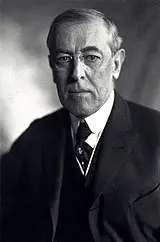
Woodrow Wilson
March 4, 1913 – March 4, 1921
28
Woodrow Wilson: The 28th President of the United States
Woodrow Wilson was the 28th President of the United States, serving two terms from 1913 to 1921. He was a visionary leader who helped to shape the modern world and is best known for his efforts to promote world peace and to create a more just and equitable international order.
Wilson was born on December 28, 1856, in Staunton, Virginia. He was the son of a Presbyterian minister and was raised in a strict religious household. He attended Princeton University, where he studied political science and history, and later earned a PhD in political science from Johns Hopkins University.
Academic Career
After completing his education, Wilson began a successful academic career, teaching at several universities and publishing several books on government and political science. He also served as the president of Princeton University from 1902 to 1910, where he implemented a number of reforms aimed at modernizing the university and making it more accessible to a broader range of students.
Political Career
Wilson’s political career began in 1910, when he was elected governor of New Jersey. He quickly gained a reputation as a progressive leader, and his successful record as governor helped to establish him as a leading candidate for the Democratic nomination for president in 1912.
Wilson ran on a platform of progressivism and advocated for a number of reforms aimed at improving the lives of ordinary Americans, including the establishment of a federal income tax, the creation of the Federal Reserve System, and the passage of antitrust legislation to break up monopolies.
Presidency
Wilson’s presidency was defined by his efforts to promote world peace and to create a more just and equitable international order. He is best known for his role in negotiating the Treaty of Versailles, which ended World War I, and for his advocacy of the League of Nations, a precursor to the United Nations.
In domestic policy, Wilson was a strong advocate for progressive reforms, including the passage of the 19th Amendment to the Constitution, which granted women the right to vote, and the establishment of the Federal Reserve System, which helped to stabilize the U.S. economy.
Despite his many accomplishments, Wilson’s presidency was also marked by controversy and conflict. He faced opposition from Republicans and some Democrats over his foreign policy and was unable to secure the passage of the Treaty of Versailles or the League of Nations.
Later Years and Legacy
Wilson suffered a debilitating stroke in 1919, which effectively ended his presidency and left him partially paralyzed for the rest of his life. He died on February 3, 1924, and is remembered today as one of the greatest American presidents and as a visionary leader who helped to shape the modern world.