
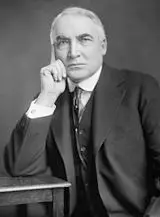
Warren G. Harding
March 4, 1921 – August 2, 1923
29
Warren G. Harding: The 29th President of the United States
Warren G. Harding was the 29th President of the United States, serving from 1921 until his untimely death in 1923. A former newspaper publisher and U.S. Senator from Ohio, Harding was known for his charismatic personality and his “return to normalcy” campaign slogan, which promised a return to the values and lifestyle of pre-World War I America.
Harding was born on November 2, 1865, in Corsica, Ohio. He was the eldest of eight children born to George Tryon Harding and Phoebe Elizabeth Dickerson Harding. Growing up, he worked on his father’s farm and attended local schools before enrolling in Ohio Central College in 1886. After graduation, he worked as a teacher and a newspaper publisher before entering politics.
Harding’s Political Career
In 1899, Harding was elected to the Ohio Senate, where he served for four years. He then ran for lieutenant governor of Ohio in 1903 but was defeated. Despite this setback, he continued to be active in politics and was eventually elected to the U.S. Senate in 1914. As a senator, he supported the League of Nations and was a strong advocate for American businesses.
Harding’s presidential campaign was characterized by his charismatic personality and his call for a “return to normalcy” after the turmoil of World War I. He won the election in a landslide, defeating Democratic nominee James M. Cox by a margin of 60.3% to 34.1%.
Presidency
Harding’s presidency was marked by a number of notable accomplishments, including the passage of the Fordney-McCumber Tariff Act, which raised tariffs on imported goods and helped protect American businesses. He also signed the Budget and Accounting Act of 1921, which established the Bureau of the Budget and helped to streamline the federal budget process.
In foreign policy, Harding was a strong advocate for the principles of the League of Nations and worked to promote peace and stability around the world. He also helped to negotiate several international treaties, including the Washington Naval Treaty, which aimed to limit the naval armaments of the world’s major powers.
However, Harding’s presidency was also marred by a number of scandals, including the Teapot Dome scandal, in which several of his cabinet members were implicated in corruption and bribery. Despite these setbacks, Harding remained popular with the American people, and he was reelected in a landslide in 1922.
Death
Tragically, Harding’s life and presidency were cut short when he died suddenly of a heart attack on August 2, 1923, while on a speaking tour of the western United States. He was 57 years old at the time of his death and is buried in Marion, Ohio. Despite the scandals and controversies that surrounded his presidency, Harding is remembered today as a charismatic leader