
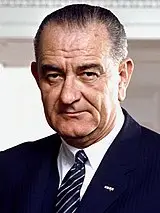
Lyndon B. Johnson
November 22, 1963 – January 20, 1969
36
Lyndon B. Johnson: The 36th President of the United States
Lyndon Baines Johnson, commonly known as LBJ, was the 36th President of the United States, serving from 1963 to 1969. Born on August 27, 1908 in Stonewall, Texas, Johnson was a seasoned politician and public figure who made significant contributions to American history and politics. Throughout his presidency, he focused on achieving his vision of a Great Society, an America where poverty, ignorance, and discrimination were eliminated and where every individual had equal opportunities to succeed.
Early Life and Political Career
Johnson was born into a family of modest means, but his ambition and drive led him to attend college and pursue a career in politics. He earned his bachelor’s degree from Southwest Texas State Teachers College (now known as Texas State University) and later taught public speaking at Sam Houston High School in Houston, Texas. During his time in Houston, Johnson became involved in local politics and quickly rose through the ranks to become the youngest member of Congress at the age of 28.
Johnson served as a Representative in the House of Representatives from 1937 to 1949, and as a Senator from 1949 to 1961. During his time in the Senate, he became known for his skills as a legislator and his ability to get things done. He played a key role in the passage of the Civil Rights Act of 1957 and the Civil Rights Act of 1960, which marked the beginning of a new era of civil rights in America.
Presidency and Domestic Policy
Johnson became the 36th President of the United States following the assassination of President John F. Kennedy in 1963. He was sworn into office aboard Air Force One and immediately set to work on his vision for a Great Society. He declared a War on Poverty, which aimed to eliminate poverty and provide economic opportunities for all Americans, and he signed into law the Economic Opportunity Act of 1964, which established the Office of Economic Opportunity and created the Job Corps, Volunteers in Service to America (VISTA), and the Head Start programs.
Johnson also signed the Civil Rights Act of 1964, which prohibited discrimination based on race, color, religion, sex, or national origin. The law was a major milestone in the civil rights movement and helped to end segregation in America. Johnson also signed the Voting Rights Act of 1965, which helped to eliminate discriminatory voting practices and ensured that all Americans had equal access to the ballot.
In addition to his domestic policy achievements, Johnson was also known for his commitment to education. He signed the Elementary and Secondary Education Act of 1965, which provided federal funding for education and helped to improve educational opportunities for children from low-income families. He also signed the Higher Education Act of 1965, which provided financial assistance for college students and helped to increase access to higher education for all Americans.
Foreign Policy and the Vietnam War
Johnson’s presidency was also marked by his foreign policy decisions, particularly in Southeast Asia. In 1965, he ordered the deployment of U.S. military forces to Vietnam, which marked the beginning of American involvement in the Vietnam War.