
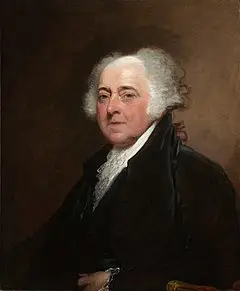
John Adams
March 4, 1797 – March 4, 1801
02
John Adams: The Second President of the United States
John Adams was an American statesman and the second President of the United States. He was a strong advocate for independence and a key figure in the American Revolution, playing a critical role in the drafting of the Declaration of Independence and serving as one of America’s first diplomats.
Adams was born on October 30, 1735, in the Massachusetts Bay Colony. He was the oldest of three children born to John Adams Sr. and Susanna Boylston Adams. He was raised in a Puritan household and was educated at Harvard College, where he graduated in 1755 with a degree in law.
Adams and the American Revolution
Adams was a strong advocate for independence from Great Britain and was one of the key figures in the American Revolution. He was a delegate to the Continental Congress and served as a key negotiator in the signing of the Treaty of Paris, which ended the American Revolutionary War and recognized the independence of the United States.
Adams was also a key player in the drafting of the Declaration of Independence, working closely with Thomas Jefferson and other founding fathers to draft the document that would become the cornerstone of American democracy. He later served as the first Vice President of the United States under President George Washington, and in 1796, he was elected as the second President of the United States.
Adams as the Second President of the United States
As President, Adams faced many challenges, including tension with France, growing political divisions within the country, and opposition from the Democratic-Republican Party, which was led by his political rival, Thomas Jefferson.
Despite these challenges, Adams was able to maintain the stability of the young country and continued the policies of his predecessor, George Washington. He was also responsible for signing the Alien and Sedition Acts into law, which were aimed at protecting national security during a time of increasing tensions with France. However, these acts were later criticized for limiting freedom of speech and were seen as a factor in Adams’ defeat in the 1800 Presidential election.
Adams’ Legacy
After leaving office, Adams retired to his estate in Quincy, Massachusetts, where he lived out the rest of his life. He continued to be active in politics and was a strong critic of President Thomas Jefferson and his administration. Despite their political differences, Adams and Jefferson reconciled in their later years and corresponded regularly until their deaths on the same day, July 4, 1826, the 50th anniversary of the signing of the Declaration of Independence.
Today, John Adams is remembered as one of the founding fathers of the United States and a key figure in the American Revolution. His contributions to the country, including his role in the drafting of the Declaration of Independence and his service as the second President of the United States, continue to be celebrated and honored.
Adams was a brilliant statesman and a passionate advocate for American independence. His legacy continues to inspire future generations, and he will always be remembered as one of the greatest figures