
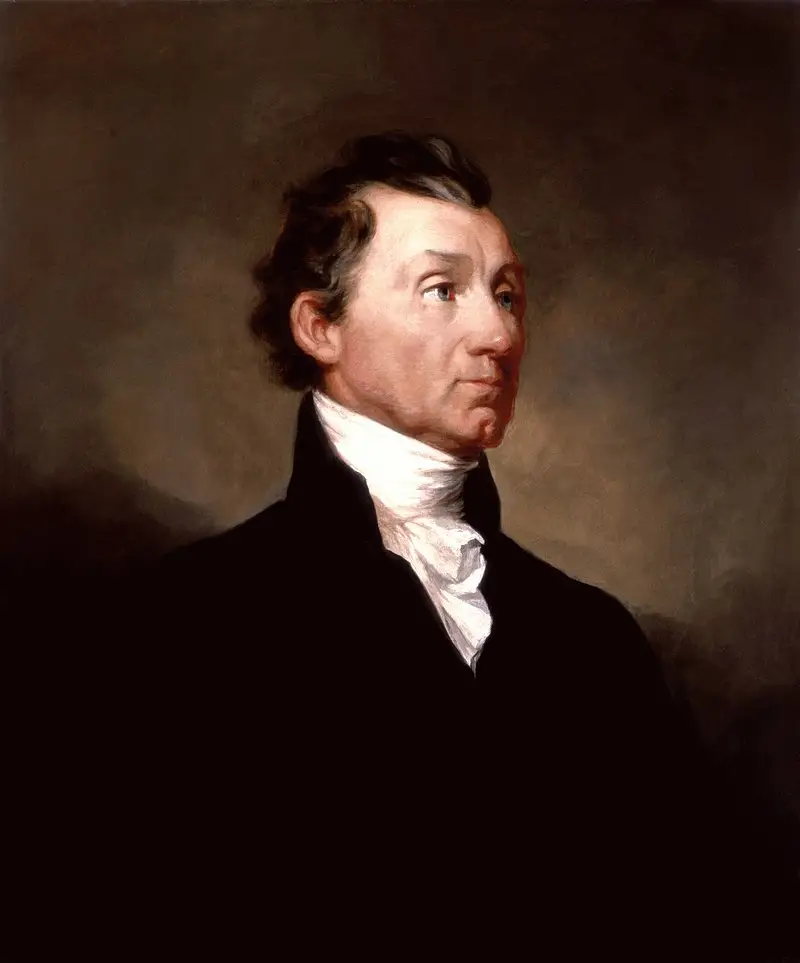
James Monroe
March 4, 1817 – March 4, 1825
05
James Monroe: The Last of the Founding Fathers
James Monroe was the fifth President of the United States, serving two terms from 1817 to 1825. He was born on April 28, 1758, in Westmoreland County, Virginia and went on to become one of the most important political figures in American history. Monroe is widely considered to be the last of the founding fathers, as he was a close contemporary of George Washington, John Adams, Thomas Jefferson, and James Madison. Throughout his life, Monroe was deeply committed to the principles of the American Revolution and worked tirelessly to ensure the preservation of the nation’s hard-won independence.
Early Life and Career
Monroe was the son of a wealthy planter and was well-educated in his youth. He attended the College of William and Mary and later served in the Continental Army during the American Revolution. After the war, Monroe studied law and was admitted to the bar in 1780. He began his political career as a member of the Virginia Assembly and later served as a delegate to the Continental Congress and as a U.S. Senator.
In 1794, Monroe was appointed as Minister to France by President Washington and served in this capacity until 1796. He then served as Governor of Virginia from 1799 to 1802 and as the U.S. Minister to Britain from 1803 to 1807. In 1811, Monroe was elected as Governor of Virginia for a second time, and in 1817 he was elected as the fifth President of the United States.
Presidency
During his presidency, Monroe was known for his commitment to national unity and for his efforts to preserve American independence. He is perhaps best known for his “Monroe Doctrine,” which was a statement of American foreign policy that declared the Western Hemisphere off-limits to European colonization and intervention. The Monroe Doctrine was a bold and influential statement that helped to define the United States as a major world power and established its role as a defender of liberty and democracy in the Americas.
Monroe’s presidency was also marked by a period of relative peace and prosperity, known as the “Era of Good Feelings.” This was a time of national unity and optimism, as the country was finally able to put the divisive issues of the Revolution and the early years of the republic behind it. During this time, Monroe also worked to expand American territory, negotiating the acquisition of Florida from Spain and supporting the exploration of the West.
Retirement and Legacy
After leaving the presidency, Monroe retired to his estate in Virginia and lived a relatively quiet life. He continued to be an important political figure and was highly respected by his fellow citizens. Monroe died on July 4, 1831, at the age of 73 and was widely mourned as a hero of the American Revolution and as one of the last of the founding fathers.
Today, James Monroe is remembered as one of the most important figures in American history. He is honored for his unwavering commitment to the principles of the American