
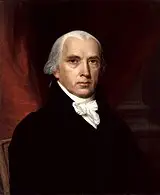
James Madison
March 4, 1809 – March 4, 1817
04
James Madison: The Father of the Constitution
James Madison was one of the founding fathers of the United States and is widely considered to be the “Father of the Constitution.” He was born on March 16, 1751, in Orange County, Virginia, and went on to become an important political figure in American history. Madison was instrumental in the drafting of the U.S. Constitution and played a significant role in its ratification. He also served as the fourth President of the United States from 1809 to 1817.
Madison was a true intellectual, with a deep love of learning and a passion for political theory. He studied at the College of New Jersey (now Princeton University) and became interested in politics at a young age. He was especially influenced by the ideas of Enlightenment thinkers such as John Locke and Montesquieu, who believed in the importance of limited government and individual rights.
The Constitutional Convention
Madison’s political career truly began in 1787, when he was selected as a delegate to the Constitutional Convention in Philadelphia. The purpose of the convention was to revise the Articles of Confederation, which were the first constitution of the United States and had proven to be inadequate in providing a strong federal government. Madison was a key figure at the convention and played a leading role in the drafting of the new constitution.
Madison was one of the jadvocates for a strong federal government and was a key player in the debate over the balance of power between the federal government and the states. He was instrumental in the creation of the system of checks and balances that is an essential part of the U.S. Constitution, which ensures that no branch of government becomes too powerful. He also played a key role in the creation of the Bill of Rights, which outlines the individual rights and freedoms guaranteed to every American.
Presidency and Retirement
After the ratification of the Constitution, Madison served in a number of important political positions, including serving as a member of the U.S. House of Representatives and as Thomas Jefferson’s Secretary of State. In 1809, he was elected as the fourth President of the United States and served two terms in office. During his presidency, Madison faced a number of challenges, including the War of 1812 and an economic depression. Despite these challenges, he was able to secure a number of important victories, including the extension of the federal government’s power over commerce and the reestablishment of a national bank.
After leaving the presidency, Madison retired to his plantation in Virginia and continued to be an important political figure and intellectual. He wrote extensively on a wide range of topics, including politics, history, and religion, and was a leading voice in the early American republic. Madison died on June 28, 1836, at the age of 85 and was widely mourned as a hero of the American Revolution and as one of the greatest minds of his generation.
Legacy
James Madison’s legacy continues to be felt today. He is remembered as one of the founding fathers of the United States