
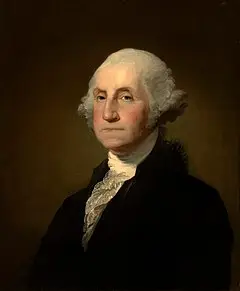
George Washington
April 30, 1789 – March 4, 1797
01
George Washington: The Father of His Country
George Washington is considered one of the most important figures in American history. As the first President of the United States and a key figure in the American Revolution, Washington is often referred to as the “Father of His Country.”
Washington was born on February 22, 1732, in Westmoreland County, Virginia. He was the first of six children born to Augustine Washington and his second wife, Mary Ball Washington. Growing up, Washington was educated in mathematics, surveying, and land management, skills that would later prove valuable in his military and political careers.
At the age of 21, Washington was appointed as the official surveyor of Culpeper County, Virginia. This was the start of his career in public service and set the foundation for his later roles as a military leader and statesman.
Washington and the American Revolution
In 1775, Washington was elected as a delegate to the Continental Congress, where he was chosen to lead the Continental Army in the American Revolution. Washington’s military leadership was instrumental in securing several key victories for the Continental Army, including the Battle of Saratoga and the Battle of Yorktown.
Washington was known for his bravery, strategic thinking, and leadership skills, which helped to galvanize the Continental Army and secure the eventual victory of the American colonists over the British. After eight long years of fighting, the Revolutionary War ended with the signing of the Treaty of Paris in 1783, and Washington returned home to Mount Vernon, his estate in Virginia.
Washington as the First President of the United States
In 1787, Washington was elected as a delegate to the Constitutional Convention, where he helped to draft the United States Constitution. He was later elected as the first President of the United States under the newly formed federal government, serving two terms from 1789 to 1797.
As President, Washington was faced with many challenges, including a weak central government, a fragile economy, and opposition from some of the more powerful states. Despite these challenges, Washington was able to establish several key policies and institutions that helped to strengthen the new federal government and set the country on a path towards stability and prosperity.
One of Washington’s most important contributions was his creation of the Cabinet, a group of advisors that he relied on for guidance and support in running the country. He also established the precedent of a two-term limit for Presidents, setting an example for future leaders to follow.
Washington’s Legacy
After leaving office, Washington returned to his estate at Mount Vernon, where he lived out the rest of his life as a respected and influential figure in American society. He died on December 14, 1799, at the age of 67, leaving behind a legacy of leadership, bravery, and statesmanship.
Today, Washington is remembered as one of the greatest figures in American history, and his contributions to the country continue to be celebrated and honored.