
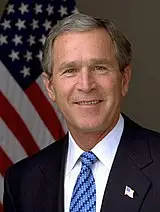
George W. Bush
January 20, 2001 – January 20, 2009
43
George W. Bush: The 43rd President of the United States
George W. Bush, born July 6, 1946, served as the 43rd President of the United States from 2001 to 2009. Prior to his presidency, Bush served as the 46th Governor of Texas from 1995 to 2000. Bush is a Republican and a member of the Bush political family, which has been prominent in American politics for over a century.
Early Life and Career
Bush was born in New Haven, Connecticut and raised in Midland and Houston, Texas. He received a bachelor’s degree in history from Yale University in 1968, and a Master of Business Administration from Harvard Business School in 1975. After graduation, Bush worked in the oil industry and was an owner of the Texas Rangers baseball team before entering politics.
Governorship of Texas
In 1994, Bush was elected as the 46th Governor of Texas. During his time as governor, Bush signed into law a number of significant reforms, including a tax cut, a school accountability system, and a tort reform package. He also oversaw the execution of 152 convicted murderers, which was the most of any governor in modern U.S. history.
Presidency
In 2000, Bush was elected as the 43rd President of the United States, defeating Democratic nominee Al Gore. His presidency was marked by a number of significant events, including the September 11th terrorist attacks, the wars in Afghanistan and Iraq, and the 2008 financial crisis.
After the September 11th attacks, Bush launched the War on Terror and invaded Afghanistan to remove the Taliban regime and al-Qaeda terrorist network. In 2003, he ordered the invasion of Iraq, citing concerns over the regime’s weapons of mass destruction program. Although no weapons of mass destruction were found, the war was successful in toppling the regime of Saddam Hussein.
In addition to his foreign policy initiatives, Bush signed into law several domestic policies, including the No Child Left Behind Act, the Medicare Prescription Drug, Improvement, and Modernization Act, and the Economic Growth and Tax Relief Reconciliation Act of 2001. However, his presidency was also marked by controversy, including his administration’s handling of the response to Hurricane Katrina and the use of enhanced interrogation techniques in the War on Terror.
Legacy
Bush left office in 2009 with a mixed legacy. While some credit him with strong leadership in the aftermath of the September 11th attacks and the successful removal of Saddam Hussein, others criticize his handling of the wars in Afghanistan and Iraq, as well as his response to Hurricane Katrina. Despite these criticisms, Bush remains a controversial figure in American politics and is widely recognized for his leadership during a time of significant challenge and change in the world.
In recent years, Bush has focused on his painting and has published several books, including a memoir entitled “Decision Points.” He has also been actively involved in a number of charitable initiatives.