
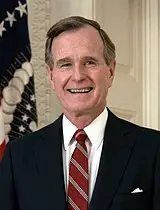
George H. W. Bush
January 20, 1989 – January 20, 1993
41
George H. W. Bush: The 41st President of the United States
George H.W. Bush, born on June 12, 1924, served as the 41st President of the United States from 1989 to 1993. Prior to his presidency, Bush had a long and successful career in politics, serving as the Vice President of the United States under President Ronald Reagan from 1981 to 1989 and as the Director of the Central Intelligence Agency (CIA) from 1976 to 1977. He was also a United States Navy veteran and served in World War II.
Early Life and Education
Bush was born in Milton, Massachusetts, to Prescott Sheldon Bush and Dorothy Walker Bush. He grew up in the wealthy suburbs of Greenwich, Connecticut, and attended Phillips Academy in Andover, Massachusetts. After graduating from Phillips Academy in 1942, Bush enlisted in the United States Navy and served as a torpedo bomber pilot in World War II. He was shot down by Japanese anti-aircraft fire in 1944 and was rescued by a U.S. submarine. Bush went on to earn degrees from Yale University, where he was a member of the Delta Kappa Epsilon fraternity and captained the Yale baseball team, and from the Harvard Business School.
Political Career
After serving in World War II, Bush began his political career by running for the U.S. House of Representatives in 1966. He was elected as a Congressman from Texas and served from 1967 to 1971. In 1971, he was appointed as the U.S. ambassador to the United Nations, and in 1973, he became the chairman of the Republican National Committee. From 1976 to 1977, he served as the Director of the Central Intelligence Agency (CIA), and in 1980, he was elected as the Vice President of the United States under President Ronald Reagan.
In 1988, Bush ran for president and was elected as the 41st President of the United States, defeating Massachusetts Governor Michael Dukakis. As president, Bush faced a number of significant challenges, including the end of the Cold War, the reunification of Germany, and the Persian Gulf War. He was also responsible for the signing of the Americans with Disabilities Act, the Clean Air Act Amendments, and the North American Free Trade Agreement (NAFTA).
Presidency
One of the most significant events of Bush’s presidency was the fall of the Berlin Wall in 1989 and the reunification of Germany. This marked the end of the Cold War and the beginning of a new era in international relations. Bush also led a coalition of countries in the Persian Gulf War, which successfully expelled Iraqi forces from Kuwait in 1991.
During his presidency, Bush faced economic challenges, including a recession and a budget deficit. Despite these challenges, he was able to secure passage of the Americans with Disabilities Act, which prohibited discrimination against people with disabilities in the workplace, and the Clean Air Act Amendments, which sought to reduce air pollution. He also signed into law the North American Free Trade Agreement (NAFTA), which eliminated trade barriers between the United States, Canada, and Mexico.