
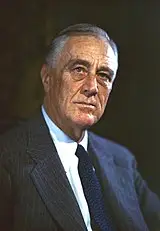
Franklin D. Roosevelt
March 4, 1933 – April 12, 1945
32
Franklin D. Roosevelt: The 32nd President of the United States
Franklin D. Roosevelt was the 32nd President of the United States, serving from 1933 until his death in 1945. He is widely regarded as one of the greatest presidents in American history, and his impact on the country and the world is still felt today. This article takes a closer look at the life and legacy of this iconic leader.
Early Life and Career
Franklin D. Roosevelt was born in Hyde Park, New York in 1882. He was the son of a wealthy and influential family, and he received a privileged upbringing and education. He went on to attend Harvard University, where he studied law and became involved in the Democratic Party.
After graduation, Roosevelt worked as a lawyer and served as the Assistant Secretary of the Navy under President Woodrow Wilson. He was elected to the New York State Senate in 1910, and he later served as the Governor of New York from 1929 to 1933.
Presidency
Roosevelt was elected President of the United States in 1932, at the height of the Great Depression. He was faced with an unprecedented economic crisis, and he took bold and decisive action to address the crisis and restore the country’s economy. He signed into law the New Deal, a series of reforms aimed at providing relief, recovery, and reform to the American people.
Roosevelt’s leadership and vision were instrumental in leading the country out of the Great Depression. He implemented a number of programs and reforms, including the creation of the Social Security program, the Works Progress Administration (WPA), and the Tennessee Valley Authority (TVA). He also signed into law the Fair Labor Standards Act, which established the 40-hour workweek and minimum wage, and the National Labor Relations Act, which protected the rights of workers to organize and bargain collectively.
In addition to his domestic accomplishments, Roosevelt was a transformative leader on the world stage. He played a key role in leading the Allies to victory in World War II, and his “Four Freedoms” speech, delivered in 1941, laid out a vision for a world based on freedom, justice, and equality. He also helped establish the United Nations, a global organization dedicated to maintaining peace and security around the world.
Legacy
Franklin D. Roosevelt’s legacy is immense and far-reaching. He is widely regarded as one of the greatest presidents in American history, and his impact on the country and the world continues to be felt today. He transformed the role of the federal government in American society, paving the way for the creation of a modern welfare state and setting the foundation for the country’s current social safety net.
Roosevelt’s leadership during the Great Depression and World War II inspired confidence in the American people and his vision and optimism helped to restore hope and optimism.