
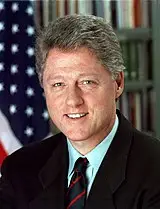
Bill Clinton
January 20, 1993 – January 20, 2001
42
Bill Clinton: The 42nd President of the United States
William Jefferson Clinton, also known as Bill Clinton, served as the 42nd President of the United States from 1993 to 2001. Born on August 19, 1946, in Hope, Arkansas, he was the first baby boomer to become President of the United States. Throughout his presidency, Clinton was known for his charisma and leadership skills, which helped him achieve several significant policy victories and maintain a high approval rating for most of his time in office.
Early Life and Political Career
Clinton was born to a widowed mother and grew up in a poverty-stricken household. Despite the challenges he faced, he was an excellent student and a natural leader, eventually becoming the student body president at his high school. He went on to study at Georgetown University, where he became involved in politics and eventually pursued a law degree at Yale University.
After completing his education, Clinton returned to Arkansas and began a successful political career. He served as the Attorney General of Arkansas from 1977 to 1979 and then as the Governor of Arkansas from 1979 to 1981 and 1983 to 1992. During his time as Governor, Clinton implemented a number of reforms and initiatives that helped improve the state’s economy and standard of living.
Presidency
In 1992, Clinton was elected as the 42nd President of the United States, defeating incumbent President George H.W. Bush. During his first term, Clinton focused on domestic policy, implementing several major reforms such as the Family and Medical Leave Act, the Brady Handgun Violence Prevention Act, and the North American Free Trade Agreement (NAFTA). He also successfully passed a major economic stimulus package, which helped revive the country’s struggling economy.
One of the defining moments of Clinton’s presidency was the passage of the Omnibus Budget Reconciliation Act of 1993, which aimed to reduce the federal budget deficit and included several tax hikes. The bill was met with significant opposition from Republicans, but Clinton’s leadership and ability to negotiate with both parties helped it pass.
In 1996, Clinton was re-elected as President, defeating Republican challenger Bob Dole. During his second term, he focused on foreign policy, playing a key role in bringing peace to the Balkans and working towards a resolution to the Israeli-Palestinian conflict. He also signed the Comprehensive Anti-Apartheid Act, which imposed sanctions on South Africa and helped bring an end to apartheid.
However, Clinton’s presidency was not without controversy. He faced several high-profile scandals, including the Whitewater scandal, which involved allegations of financial improprieties related to real estate investments, and the Monica Lewinsky scandal, which led to his impeachment by the House of Representatives in 1998. Despite the scandals, Clinton’s approval rating remained high, and he left office with a positive legacy.
Post-Presidency
After leaving office, Clinton continued to be an active and influential figure in American politics. He established the William J. Clinton Foundation, which works towards improving global health and combating climate change, among other initiatives.