
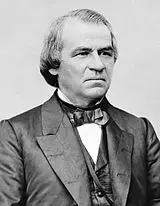
Andrew Johnson
April 15, 1865 – March 4, 1869
17
Andrew Johnson: The 17th President of the United States
Andrew Johnson was the 17th President of the United States, serving from 1865 to 1869. He was Vice President under Abraham Lincoln and became President after Lincoln’s assassination in April 1865. Johnson, a Southern Democrat from Tennessee, faced significant opposition during his presidency, particularly from Radical Republicans in Congress who were dissatisfied with his reconstruction policies.
Johnson was born in Raleigh, North Carolina in 1808. He was apprenticed as a tailor and worked in that trade for most of his life before entering politics. He served in both the Tennessee state legislature and the United States House of Representatives before being elected to the United States Senate in 1857.
Johnson’s political views were shaped by his background as a Southern Democrat and his opposition to secession. He was the only Southern Senator to remain loyal to the Union during the Civil War, and his stance earned him the nickname “The War Governor.” He was selected as Lincoln’s running mate in the 1864 election, and became Vice President when Lincoln was reelected.
Presidency
Johnson’s presidency was marked by conflict with Radical Republicans in Congress who sought to impose a more radical reconstruction policy on the South. Johnson’s own reconstruction policies were more moderate, and he opposed many of the Radical Republicans’ proposed laws, including the Freedmen’s Bureau bill and the Civil Rights Act of 1866.
The conflict between Johnson and the Radical Republicans came to a head in 1867, when Johnson vetoed a bill that would have extended the life of the Freedmen’s Bureau, an agency established to assist freed slaves. The veto was overridden by Congress, marking the first time in American history that a President’s veto had been overridden by Congress.
Johnson’s presidency was also marked by controversy over his firing of Edwin M. Stanton, the Secretary of War. Johnson accused Stanton of opposing his reconstruction policies and removed him from office in February 1868. The move was seen as an abuse of power and led to Johnson’s impeachment by the House of Representatives in 1868.
Johnson narrowly avoided removal from office after being acquitted by the Senate in 1868. The impeachment trial, however, damaged Johnson’s reputation and political standing, and he did not seek reelection in 1868.
Legacy
Andrew Johnson’s presidency is often remembered as one of the most turbulent and controversial in American history. He was the first President to be impeached, and his impeachment trial and removal from office were narrowly avoided only due to his acquittal by the Senate.
Johnson’s reputation has improved over time, however, and many historians view him as a sympathetic figure who was caught in a difficult political situation. Despite his many challenges, Johnson remains an important figure in American history and is remembered for his role in the tumultuous period of Reconstruction after the Civil War.
Andrew Johnson died in July 1875 at the age of 66. He is buried in Greeneville, Tennessee, his hometown and the place where he began his political career.