
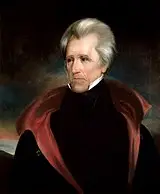
Andrew Jackson
March 4, 1829 – March 4, 1837
07
Andrew Jackson: The People’s President
Andrew Jackson was the 7th President of the United States, serving two terms from 1829 to 1837. He was born on March 15, 1767, in Waxhaw, South Carolina, and was the first president to be born in a log cabin. Jackson was a war hero, having served in the American Revolution and the War of 1812, and he was a fierce defender of American interests and values. He was known for his strong personality, his populist political style, and his commitment to the rights of the common man.
Early Life and Career
Jackson grew up in poverty and received little formal education, but he was a natural leader and a fierce fighter. He served in the American Revolution as a teenager, and he was captured by the British and held as a prisoner of war. After the war, he became a successful lawyer and planter in Tennessee, and he served in the Tennessee militia and in the U.S. House of Representatives.
In 1815, Jackson gained national fame as a war hero after he led American forces to victory against the British at the Battle of New Orleans. He was widely regarded as a symbol of American bravery and determination, and he used this notoriety to launch a successful bid for the presidency in 1828.
Presidency
Jackson’s presidency was marked by major changes in American politics and society. He was a populist president who believed in the power of the people and sought to increase their influence over the government. He dismantled the Second Bank of the United States, which he saw as a corrupt institution that served the interests of the wealthy, and he vetoed the renewal of its charter. He also signed the Indian Removal Act of 1830, which led to the forced relocation of thousands of Native American tribes from their ancestral lands in the southeastern United States to Indian Territory in present-day Oklahoma.
Despite these controversial actions, Jackson was immensely popular with the American people, who saw him as a champion of the common man. He was reelected in 1832 and continued to advance his populist agenda, supporting measures such as reducing the national debt, lowering tariffs, and expanding the rights of western settlers. Jackson’s presidency marked the beginning of a new era in American politics, as the country shifted away from the aristocratic, elitist politics of the past towards a more democratic and populist system.
Retirement and Legacy
After leaving the presidency, Jackson retired to his plantation in Tennessee, where he lived until his death in 1845. He remains one of the most controversial and influential figures in American history, and his legacy continues to shape American politics and society to this day. He is often remembered as the champion of the common man, the defender of American values, and the architect of a new, populist vision for American democracy.