
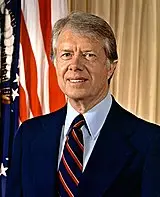
Jimmy Carter
January 20, 1977 – January 20, 1981
39
Jimmy Carter: A Legacy of Peace, Human Rights, and Community Service
Jimmy Carter, the 39th President of the United States, served from 1977 to 1981 and is widely recognized for his efforts towards peace and human rights. Born on October 1, 1924, in Plains, Georgia, Carter grew up in a farming community and went on to attend the United States Naval Academy. After serving as a naval officer for seven years, he returned to Georgia to run the family peanut farm and entered politics.
In 1976, Carter was elected as the President of the United States, winning the election with a promise to restore integrity and honesty to the government. He brought a new level of transparency and accountability to the White House, becoming known for his commitment to human rights and his ability to negotiate peaceful solutions to international conflicts.
Carter’s Foreign Policy: A Focus on Peace and Human Rights
One of the major focuses of Carter’s presidency was foreign policy. He was dedicated to promoting peace and human rights and worked tirelessly to broker agreements and negotiate settlements between warring nations. One of his biggest foreign policy achievements was the Camp David Accords, which he brokered between Israel and Egypt in 1978. This agreement helped to establish a lasting peace between the two nations and is widely recognized as one of the most significant diplomatic achievements of the 20th century.
In addition to his work in the Middle East, Carter also made efforts to negotiate peace in other regions around the world. He normalized relations with China, and helped to end the civil war in Nicaragua by negotiating the Esquipulas II Accords. Carter also made significant contributions towards arms control, signing the SALT II treaty with the Soviet Union in 1979, which aimed to reduce the number of nuclear weapons in both countries.
Carter’s Domestic Policies: A Focus on Energy Independence and Human Rights
In addition to his foreign policy achievements, Carter also made significant contributions to domestic policy. One of his major focuses was energy independence, and he pushed for the development of alternative energy sources and the conservation of energy. He also established the Department of Energy and signed the National Energy Act, which aimed to reduce the nation’s dependence on foreign oil and promote energy efficiency.
Carter was also a strong advocate for human rights and worked to end discrimination and promote equality. He signed the Civil Rights Act of 1978, which strengthened the rights of minorities, women, and disabled individuals. He also created the White House Office of Communications to improve communication between the government and the public, and he established the National Consumer Cooperative Bank to promote economic development in rural communities.
Jimmy Carter: A Legacy of Service
After leaving office, Carter continued his dedication to peace, human rights, and community service. He founded the Carter Center in 1982, which is dedicated to promoting peace, health, and human rights around the world. The center has been instrumental in resolving conflicts and promoting democracy in many countries, and it has also helped to improve health and reduce poverty in developing nations.