
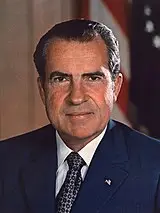
Richard Nixon
January 20, 1969 – August 9, 1974
37
Richard Nixon: The 37th President of the United States
Richard Nixon was the 37th President of the United States, serving from January 20, 1969 to August 9, 1974. He is the only U.S. president to resign from office. Despite his controversial legacy, Nixon is remembered for his foreign policy initiatives and efforts to improve relations with the Soviet Union and China.
Early Life and Political Career
Richard Nixon was born on January 9, 1913 in Yorba Linda, California. He graduated from Whittier College in 1934 and Duke University School of Law in 1937. After practicing law in Whittier, California, he was elected to the U.S. House of Representatives in 1946, representing California’s 12th congressional district. In 1950, he was elected to the U.S. Senate and was reelected in 1956.
Nixon was Dwight D. Eisenhower’s running mate in the 1952 presidential election, and he became the Vice President of the United States in January 1953. He served as Vice President until January 1961, when Eisenhower’s second term ended. In 1960, Nixon ran for president against John F. Kennedy, but he lost the election.
Presidency
Nixon was elected president in 1968, defeating Democratic candidate Hubert Humphrey. During his first term, Nixon pursued a foreign policy of détente, seeking to improve relations with the Soviet Union and China. He also ended U.S. involvement in the Vietnam War and established the Environmental Protection Agency.
One of Nixon’s most significant achievements was the opening of relations with China. In 1972, he made a historic visit to China, where he met with Chinese leader Mao Zedong. This visit marked a major turning point in U.S.-China relations and set the stage for the normalization of relations between the two countries.
In addition to his foreign policy initiatives, Nixon implemented a number of domestic policies, including the creation of the Occupational Safety and Health Administration and the expansion of federal aid for education. He also proposed a national health insurance plan, but it was never enacted into law.
Watergate Scandal and Resignation
Nixon’s presidency was marred by the Watergate scandal, which was a series of political crimes and abuses of power committed by Nixon and his administration. The scandal began with the break-in at the Democratic National Committee headquarters at the Watergate complex in Washington, D.C. in June 1972. The break-in was part of a larger effort to gather intelligence on the Democratic Party and to sabotage the opposition’s campaign efforts.
As the Watergate scandal unfolded, Nixon faced growing pressure to resign. In August 1974, he resigned from the presidency, becoming the first U.S. president to do so. After his resignation, Nixon was succeeded by Gerald Ford, who pardoned him for any federal crimes he may have committed while in office.