
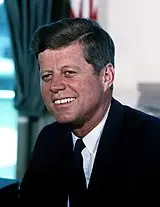
John F. Kennedy
January 20, 1961 – November 22, 1963
35
John F. Kennedy: The 35th President of the United States
John F. Kennedy, also known as JFK, was the 35th President of the United States, serving from 1961 until his assassination in 1963. He was one of the youngest Presidents in American history, and he is remembered for his charisma, his vision for the country, and his impact on American culture. This article takes a closer look at the life and legacy of this iconic leader.
Early Life and Political Career
John F. Kennedy was born in Brookline, Massachusetts in 1917. He was the second of nine children, and he grew up in a politically active family. He attended Harvard University, where he graduated with a degree in government in 1940. He went on to serve in the U.S. Navy during World War II, and he was awarded the Navy and Marine Corps Medal for his service.
After the war, Kennedy entered politics, and he was elected to the U.S. House of Representatives in 1946. He was elected to the U.S. Senate in 1952, and he quickly established himself as a rising star in the Democratic Party. In 1960, he ran for President of the United States, and he defeated Richard Nixon in one of the closest Presidential elections in American history.
Presidency
Kennedy became President of the United States in 1961, and he immediately set about implementing his vision for the country. He was a charismatic leader who inspired millions of Americans with his idealism and his commitment to progress. He is perhaps best known for his efforts to advance civil rights, and he is credited with signing the Civil Rights Act of 1964, which outlawed segregation in public places.
In addition to his domestic policies, Kennedy is also remembered for his efforts to improve relations with the Soviet Union and to prevent the spread of communism. He established the Peace Corps, which sent young Americans abroad to help with development efforts in other countries, and he also helped to negotiate the Limited Nuclear Test Ban Treaty, which limited the testing of nuclear weapons by the United States, the Soviet Union, and the United Kingdom.
Kennedy is also remembered for his efforts to put a man on the moon. In 1961, he declared that the United States would put a man on the moon by the end of the decade, and he committed the country’s resources to achieving this goal. The Apollo 11 mission, which landed astronauts Neil Armstrong and Buzz Aldrin on the moon in 1969, was a testament to Kennedy’s vision and leadership.
Legacy
John F. Kennedy’s legacy is one of hope, progress, and idealism. He inspired millions of Americans with his vision for the country, and he remains one of the most popular Presidents in American history. Despite his untimely death, his impact on American culture and politics continues to be felt today.