
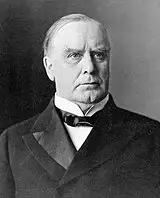
William McKinley
March 4, 1897 – September 14, 1901
25
William McKinley: The 25th President of the United States
William McKinley was the 25th President of the United States, serving two terms from 1897 until his assassination in 1901. He is remembered as a capable leader who oversaw significant expansion of American industry and territorial acquisitions during his time in office.
Early Life and Career
William McKinley was born on January 29, 1843, in Niles, Ohio. He grew up in a family of modest means and was educated at Mount Union College in Ohio. After college, he worked as a teacher and later, as a lawyer. He served in the Union Army during the American Civil War and later entered politics, serving in the House of Representatives and later, as Governor of Ohio.
Presidency
McKinley was elected President in 1896 and was reelected in 1900. During his presidency, he is remembered for his successful efforts to negotiate a settlement in the Spanish-American War and for his role in overseeing the acquisition of new territories, including Hawaii and Puerto Rico.
McKinley was also a strong advocate for American industry and commerce, and he worked to implement protective tariffs and other measures to support American businesses. He is remembered for his efforts to promote economic growth and prosperity during his time in office.
Assassination
McKinley was assassinated on September 6, 1901, while attending the Pan-American Exposition in Buffalo, New York. He was shot by Leon Czolgosz, an anarchist, and died eight days later of his wounds. His Vice President, Theodore Roosevelt, succeeded him as President.
Legacy
William McKinley remains an important figure in American history, remembered for his efforts to promote American industry and commerce, and for his role in overseeing territorial expansion and the settlement of the Spanish-American War.
McKinley’s legacy is often overshadowed by the larger-than-life personalities of Presidents like Theodore Roosevelt and Abraham Lincoln, but his contributions to American history are nonetheless significant. He remains a symbol of the strength and resilience of the American people, and his legacy continues to inspire future generations of leaders.