
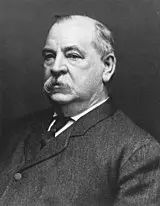
Grover Cleveland
March 4, 1885 – March 4, 1889 AND March 4, 1893 – March 4, 1897
22, 24
Grover Cleveland: A Look at the 22nd and 24th President of the United States
Grover Cleveland was a notable figure in American history, serving as the 22nd and 24th President of the United States. He was born on March 18, 1837, in Caldwell, New Jersey, and died on June 24, 1908, in Princeton, New Jersey. Cleveland was the only U.S. President to serve two non-consecutive terms in office and was known for his integrity, conservatism, and commitment to the principles of classical liberalism.
Early Life and Career
Cleveland’s childhood was marked by poverty, as his father died when he was just 16 years old. Despite these circumstances, Cleveland was determined to make something of himself and worked hard to provide for his family. He worked as a clerk in a law office and eventually went on to study law, which led him to a successful career as a lawyer and politician.
Cleveland’s political career began in the 1870s, when he was elected Sheriff of Erie County, New York. He went on to serve as Mayor of Buffalo, New York, and was eventually elected as the Governor of New York in 1882. Cleveland’s time as governor was characterized by his efforts to combat political corruption and to promote fiscal responsibility, which helped to establish his reputation as a man of integrity and a competent administrator.
Presidency (1885-1889)
Cleveland was elected as the 22nd President of the United States in 1884, running as a Democrat. He was known for his conservative views and his commitment to fiscal responsibility, and he worked to reduce the national debt and to reduce the size of government. He also took a hardline stance on labor issues, opposing efforts to organize unions and striking workers.
One of the most notable events of Cleveland’s first term was the Pullman Strike of 1894, which was a nationwide railway strike that disrupted commerce and transportation. Cleveland responded by sending in federal troops to break up the strike, a move that was criticized by some as being too harsh. However, Cleveland defended his actions, stating that the strike threatened public safety and that it was necessary to protect the rights of all citizens.
Cleveland’s first term was also marked by his efforts to promote tariff reform and to reduce the influence of special interest groups. He was committed to maintaining a strong currency and to promoting economic stability, and he worked to prevent the passage of laws that would have benefitted specific industries or businesses.
Presidency (1893-1897)
Cleveland was defeated in the election of 1888, but he made a successful comeback in 1892 and was elected to his second term as President. During his second term, Cleveland continued his efforts to reduce the size of government and to promote fiscal responsibility, but he faced numerous challenges, including an economic depression and a growing movement for increased government intervention in the economy.
One of the most significant events of Cleveland’s second term was the Panic of 1893, a major economic depression that lasted for several years.